Connect with us _

t: 01308 861113

Blog Making it easy to buy green!

> checkout

Wednesday, 6 November 2013

The Inspiration behind Hergest Handmade Handbags

Our Featured Seller this month is Hergest Handmade Handbags.  Her beautiful yet fun handbags are sure to put a smile on any girls face - we love them, and the story behind them...

How did you get started?
I started with my handbag business by initially making bags for my self and friends. you know when there's something else going on when people come out of shops and the the street to ask where you got your bag from. One day this happened to me 5 times!

A key aspect of my business and also of everything i do in life is to buy British. This has become more relevant since I have became a designer / Maker. So my website and even my marquee for my events is made in Britain. You have to practise what you preach. I also strongly believe this is crucial to the economy of this country. We used to be a great manufacturing country and that's (in part) what made Britain Great! 

With my tweed bags I use British only, of course. I currently source from Scotland and I look to the less high profile weavers, I source from Ireland, England there are some great weavers here, from the Islands including the Isle of Man and also locally to me from Powys in Wales where the weaver lives just over the border from me and only 8 miles away.

 Who is the person you most admire?  My Dad. He has the patience of a saint, gives sound advise, whether it's what you want to hear or not!
What you like to listen to? I listen to Classic Fm constantly, when I am sewing on my old Roberts radio.
What is your favourite item of clothing? A beautiful Tweed coat. Handmade in England, of course. I wear it everywhere
What is your favourite drink?  Butty Bach from the Wye Valley Brewery 
Describe your perfect evening? Sitting in a restaurant in the town square in Sienna or Florence with my family. 
Where would you go on your perfect holiday? Touring tuscany and staying in Sienna. My husband loves the art and architecture and my children and I love the food and weather!

Friday, 13 September 2013

The Inspiration behind - Heavenly Hedgerows

Our Featured Seller this month is Heavenly Hedgerows.  With their Lavender Jelly they have just wowed judges in Great Taste 2013 by being awarded 3-stars.  Of the nearly 10,000 products entered only 125 foods achieved the three gold stars!

As well as their range of preserves and drinks they also produce an amazing all natural hand cream - we love it!

How did you get started? - Heavenly Hedgerows started as a hobby, borne out of an outdoorsy New Zealand childhood, in which my mum would take her three girls foraging for breakfast mushrooms and edible flowers. When I married an Englishman, Dave, I was delighted to discover he too had a love of foraging, so we used to hunt the hedgerows around Bristol together. I often had too much bounty for my own family, so started making liqueurs and jellies for friends and extended family. They enjoyed these Christmas goodies so much, that they encouraged me to have a stall at a farmers market. This turned out to be quite a success and the business grew from there. I needed a name for my produce, and ‘Heavenly Hedgerows’ seemed the obvious choice, as the berries they produce are just that!
Family consists of myself, husband Dave and our three kids Rosa, Stanley and Magnus (12, 9 & 7). Most weekends are taken up with the children’s swimming and cricket, but we try and make as much of the countryside as we can in our spare time, and love to go camping. I love it when the kids get feral, use their imagination and build dens in the woods – far away from technology.
Picking wild food for commercial purposes is illegal without the landowner’s permission, so we are blessed to have the green light to pick on three local farms with an acreage totalling nearly 2,000. This large area makes picking sustainable. We need never pick from the same spot and are careful to leave plenty for birds and re-seeding. We’ve also planted hedgerow around our property, and some fruit trees; these help make up some of our ‘limited edition’ range of liqueurs, which is coming soon.
Person you most admire -  My first boss. He started his business from a spare room at home, and is now New Zealand’s biggest ‘business seller’ – that is, he sells going-concern businesses. Where I considered myself a shy, nervous girl, he saw potential. And with consistent teaching, encouragement and support he gave me the wings to fly. Now, I’m able to help others do the same.

What do you like to listen to - When out foraging, I thrive on the so-called silence of nature – bird song, buzzing insects, the communication between animals and whisper of wind in the trees. But I love cranking up The Tallest Man on Earth and The National when I need to feel motivated!
Favourite Drink - My favourite tipple is something very English - a classic cup of English Breakfast Tea, followed closely by a quality G&T.
Perfect holiday - As you will have guessed, I’m a sucker for The Great Outdoors. My favourite holiday is anything that involves walking. It’s a wonderful way to engage with nature and see the world – and I have to recommend my homeland New Zealand for this. The native Bush (forest), extraordinary trees and exotic bird-life are to die for – and let’s not forget this is where you find Manuka and its healing properties.
Ideal evening - I love winter. It gives me a chance to relax after the busy picking period of Autumn. My favourite evening involves lots of good food, friends and family, the log burner on and a little whiskey to smoothly while away dark nights.

Favourite Item of Clothing - I picked up a red poncho from a car boot sale for 20p about 5 years ago. It makes me feel like little red riding hood – someone else who spent a lot of time in the woods -  without the hood!

Tuesday, 9 July 2013

James Strawbridge

James Strawbridge came to our attention back in 2006 when cameras followed his Dad, Dick Strawbridge and family as they setup their own off grid small holding in the BBC 2 series It's Not Easy Being Green  focusing on how to live an environmentally friendly, low impact life.
James now lives in Cornwall with his young family. Digging the earth and growing much of their own food which both keeps him fit and healthy and has enabled him to learn about sustainability and self-sufficiency on a practical level.
In 2012 James co-founded the PoshPasty Company ™ and now spends all the time when he isn’t filming or writing making gourmet pasties and preserves.
Having been living the green life for many years, he is a true sustainable living expert.   This is why we wanted to dig a little beneath the surface to find out what makes him tick…

What would your dream world look like?

'Living the dream' is a phrase that you hear thrown around the place when people are in a particularly good mood or often whilst they're on holiday. At points many of us feel that we have glimpses of what life is really about - family, sunshine, music, relaxing, and being outdoors. I am lucky enough to say that at the moment I'm living my dream. I have a lovely family; my wife Holly and two beautiful children Indiana and Pippin, I live near the sea on the banks of the river Fowey in Cornwall and have great routine of rowing and sailing, I eat well and have an honest pasty making job on an eco- farm. It all sounds too good to be true and sometimes I do pinch myself but my dad told me that "you make your own luck" and I've worked really hard. I think that my idea of a dream world is real as long as you don't want too much. For me the grass isn't greener on the other side - I like my small garden and appreciate the view from it.

If you choose to get involved in your local community you will make friends, if you choose seasonal food you can eat well, if you spend time outside then you will have a healthy glow and feel happier, if you want to live the dream then yes, love dreaming - but make your ideals come true one small step at a time.

In my dream world people who have always wanted to travel could start with weekend walks on coastal paths and then follow their feet on towards bigger  adventures. People who want to run their own restaurant could start with feeding their neighbours at an open BBQ. People who call themselves dreamers could wake up and live it one reality at a time...

Who would be your perfect dinner guest ?

My perfect dinner guest would be Herman Hesse - if I spoke German... He is my favourite writer and I've read every single thing he's written. I'd love to see if we got on and get a slice of advice. I'd cook a trio of German sausages with homemade sauerkraut served with a chilled bottle of Gewürztraminer. Plus I'd make sure we had some gypsy jazz playing to capture the sense of his time.

What is your favourite book?

Knulp by Herman Hesse

Best way to relax?

Gig rowing (Cornish rowing at sea in big wooden boats with a crew of six) for me this clears my head of everything but the oar, timing and waves of water. It might not be physically relaxing but for me it calms my mind.

Your perfect supper?

The next one.

Your ultimate album of 7 songs?

Empires made of Sand - Charlotte Strawbridge
Coope Boyes & Simpson - Jerusalem revisited
And Brun - Changing of the Seasons
Eddie Vedder - Society
Jaques Brel - Amsterdam
The Outlaws - Green Grass and high tides
Rodriguez - crucify your mind

Featured Seller - Cyril's Soap Shed

How did you get started -  Cyril’s Soap Shed came about pretty much by accident! I gave up my full time job to start a family in 2006. We were already on the road to self suffiency with our chickens and vegetable gardens, and so we decided to get a goat for milk. We decided on one goat, however to cut a long story, we came back from the local activity farm with 2 goats. Penny and Florence. The following year they kidded and started producing LOTS of milk, despite me not taking the kids away from mum, they were still providing us with over 8 pints a day!

I spent my days making milk puddings, whey cakes and learning how to make cheese. All this was helping to use the milk, but I needed to find something else. After a bit of research I discovered that Goats Milk Soap was becoming increasingly popular due to the fantastic skin loving qualities that the goats milk had. So I set about learning how to make soap! I quickly learnt that I wanted to do it ‘properly’ and from scratch, and that the Cold Process method, although more time consuming, would produce the best soaps. We only use ethically sourced base oils, and while these cant be 'local' (We use Olive, Coconut, Cocoa Butter and sustainable palm, as we feel these oils make the best soap for us) to The New Forest, or even England, we source from small reputable companies. Our Essential Oils for the Fragrance we use a local company, and the herbs we use are either grown in our garden, or come from the New Forest.

After I thought I had perfected my recipe and method I gave some to friends and family who were so impressed they thought I should sell it. After getting my safety assessment I booked a stall at the local market. The soaps were really popular, and I had many people come back again, saying how the soaps had helped their skin, especially eczema sufferers. That is the nicest part I think! Knowing that the soaps had been able to help someone. I always let the goats know too! Every nice email I get I read to the goats, as it is their milk which is the magic ingrediant!!

I also needed a name for the company. Thats where Cyril comes into it! Cyril was my Grandad, who had a shed at the bottom of the field. The shed was the hub of the local community for all the old folk! Many a day they would be sat in the ‘shed’ putting the world to rights (normally while drinking his homemade ‘scrumpy’!) When Grandad moved on to the great shed in the sky, his shed down here became a bit worse for wear. When the time came for myself and husband to have our own home, we decided to resurrect the old shed. So we built our log cabin home on the same spot.

Things have moved on since the first days of ‘Cyril’s Soap Shed’. Instead of just one or two markets a month, we now do anything up to ten events a week, including New Forest Producer markets, County shows and various events going on around us. The markets and shows have led to us being ‘seen’ and approached by various other business’. This led to us supplying an ever growing range of farm shops, gift shops and local village stores, mainly in and around the New Forest, but we can go as far and wide as anyone wants! We currently have around 16 stockists, and supply 8 hotels and guest houses with guest bars.

Person you most admire - My Husband!! It may sound not very adventerous, but he is a true inspiration to me. He works so hard holding down a full time job with different shift patterns, he helps me by cutting all the paper needed for wrapping, does most of the labelling and he is my top seller! He even does markets etc after a night shift at work! On top of that he does most of the small holding maintenance, looks after the veggies, and is a brilliant Dad! I just love his energy.

What you like to listen to - I spend most of my days in my kitchen making soaps with Essential Oils, which quite often varies my mood, which varies which music i Listen to! I quite like Country and folk music, Ruth Moody is a favourite, Alison Krauss, Patsy Cline, The Lumineers, Mumford and Sons, Pink Floyd, Led Zep and Fleetwood Mac are all on my 'Soaping playlist' too!

Favourite Item of Clothing - My crocs!! I live in my crocs. Being on my feet all day I need something comfortable, and I hate wearing anything tight on my feet.

Favourite Drink - Cup of tea!

Ideal evening - Warm summers evening riding my horse in the forest.

Perfect holiday - Any!! With the goats which need milking daily, and all of our other animals, holidays are virtually impossible. However if we could go away, we would do a King Arthur trail around Britain, and visit all the sites that are connected to King Arthur.

Friday, 21 June 2013

Featured Seller

We love the natural range from our first featured seller, Rosie Ellis of Bespoke Confetti, and really wanted to find out more about this wonderful business.

Rosie grows organically many native flowers from which they create colourful all natural confetti and real petal papers - perfect for a special celebration.  She has also forged relationships with local artisan basket weavers who use their local Somerset willow to make baskets just for her.  These are baskets that make you want to replace shopping bags.  Her range is available through her Muddy Carrot shop.

Here is a little view behind the scene of this lovely green business.

Bespoke Confetti

How did you get started - well a long story, but it's not an original idea, as there are some very large growers of petal confetti in the UK.
However our ethos became growing flowers organically, to handpick the petals & provide a real petal confetti as ecologically as possible. To that end, no chemicals, dyes or other intervention, other than hard work, goes into every single petal of confetti.Our labour force are the local 6th form students and university students home for the holidays.We provide petals for petal paper and sell a range of bespoke confetti baskets from Somerset willow, made by a local lady weaver especially for us.
So here we are, year 5, with a very successful small business growing a product that we are immensely proud of, keeping a small colony of bees & extending our business to incorporate other local enterprises with the same business ethic.

I am very passionate about the British flower industry, and the resurgence of interest in British flowers has been amazing. We have extended our business into growing seasonal flowers for a local high street florist & have recently been part of The Natural Wedding Company roadtrip, visiting sustainable and ethical businesses in the South West.
The person you most admire - Women in business in general, but one of our local Somerset based business women, Deborah Meaden She supports small businesses, has a very keen eye for regeneration & sustainability, and I feel is balanced in her approach to life.

What you listen to - in the background - Absolute radio - I have to be able to concentrate & find that radio 4/5 can be quite distracting. In my quiet times, Cohen has always been a firm favorite, but I rarely have quiet times.
Your favourite item of clothingHas to be my hoe - seen wearing it most days!
Your favourite drink - Gin and tonic - Plymouth gin! Or a chilled Pouilly Fuisse
Perfect holiday - Has to be somewhere warm where, for R & R, I can recharge the batteries and read a good book!

Tuesday, 4 June 2013

5 key facts you should know about your soil

Soil may not seem a sexy topic, let’s face it – it’s commonly referred to as dirt.  But, with a name like Muddy Carrot, we're bound to bring it up at some point! 
So is it important for our every day life?
Yes, it is vital, it is what our very existence is built on, and before you dismiss it as something just for the interest of farmers - let's take a closer look at the soil beneath your feet:
  • We depend on it, and its health, for all the food we eat.  It is key to our whole food chain, from fruit and vegetables to the plant life that sustains the animals on our farms and in the wild.
  • Though it covers a third of the planet’s surface, we know less about soil than about space.  This may seem bonkers, but soil is very complex.  A handful of soil has more micro-organisms in it than there are people on the planet. It’s full of microbial life.  It is because of all this life in the soil that we can grow healthy food.
  •  Much carbon is locked up in soil.  In fact there’s twice as much carbon locked away in the soil as there is in the atmosphere.  The organic matter we add to our soil in the form of mulching, composted plant material and animal manure is all carbon based.  A 1% increase in organic matter on 1 acre of land will lock multiple tonnes of carbon out of the atmosphere.  There is great potential for building soils in this way where they’ve been degraded over the last couple of hundred years.  This has the added benefit of improving the fertility of the land we grow on, not through artificial chemicals but through more sustainable organic matter.
  • Soil can and is being eroded and compacted throughout the world.  This is most noticeable on soil on slopes.  Once we remove the plants growing on the surface of the soil, rain will soon wash the soil, and the goodness within it, away.  This is why clearing trees from hillsides to grow crops can have a devastating effect on it, and why rainforests can become desert.  
  • Soil has many layers.  There is a rich surface layer full of the organic matter from decomposing plants, and added organic material, followed by the top soil and then the sub-soil.   Soil comes in varying mixes of sand, silt and clay, and the proportions of these elements determines the ‘type’ of soil you have.  A healthy garden soil should be teeming with worms moving goodness around the garden, and helping to keep the soil aerated.
You can help the environment by caring for the soil in your own garden.  Very simple things can make a big difference.  By learning how to make your own compost, mulching over the top of your garden beds and growing insect-friendly plants you can all have a positive effect on the environment.

How are you using your garden?

Tuesday, 7 May 2013

Create your own Edible Polyculture

"Our daily bread" is something most people in Britain have taken for granted for many years.  Food and drink is the UK’s largest industry worth £80Bn per year.  But although the UK has a thriving farming sector we still import 40% of the total food consumed and the proportion is rising.  This is a big reliance on food grown elsewhere in the world, especially with climate change affecting our food chain more and more.

There are now more signs of the strain put on our food industry.  In 2008 there was a spike in food prices in the global markets due to poor harvests - wheat prices rose 130%, soya by 87% and rice by 74%. 

Drought, food and water shortages are now affecting many more parts of the world. Richard Choularton, a senior policy officer in the U.N. World Food Program’s climate change office said “We should expect much more political destabilization of countries as it bites. What is different now from 20 years ago is that far more people are living in places with a higher climatic risk: 650 million people now live in arid or semi-arid areas where floods and droughts and price shocks are expected to have the most impact.”

This is very sobering stuff, and puts in perspective the need for food security and sourcing local, both to ensure we can continue to feed ourselves as well as reducing our impact on the rest of the world.  

Have you thought of growing some of your own food, but have little time?

If you’ve got some outdoor space it's amazing how easily you can grow a little bit of food for minimal effort.  I’m not talking a high maintenance veg patch, but simply adding plants into the garden that produce a harvest for you whilst also benefiting our local bee and insect population.  Over the next few months we will be looking at a few simple combinations of plants that benefit each other and could bring you a small harvest.

Create Mulberry edible polyculture :


Mulberry tree – not often seen these days (but through no fault of its own) it produces delicious red or black raspberry shaped fruit that  are rarely seen in the shops It was originally brought into Britain in the Tudor times  in the hope that it would be useful in the cultivation of silkworm. The mulberry tree is beautiful – it has a spreading habit and becomes crooked and gnarled with time, with attractive leaves. If space is limited it can be grown against walls.

Grape vine – if you’re lucky enough to have a larger specimen you can plant a grape vine through it.  The mulberry has a positive effect on the health of a vine.

Hyssop – This attractive medicinal perennial herb will attract bees.   It has a positive effect on encouraging the growth of grapes.

Jostaberry, sage and other perennial herbs are also known to work well with this grouping.

Tuesday, 12 March 2013

Wild Garlic Recipes

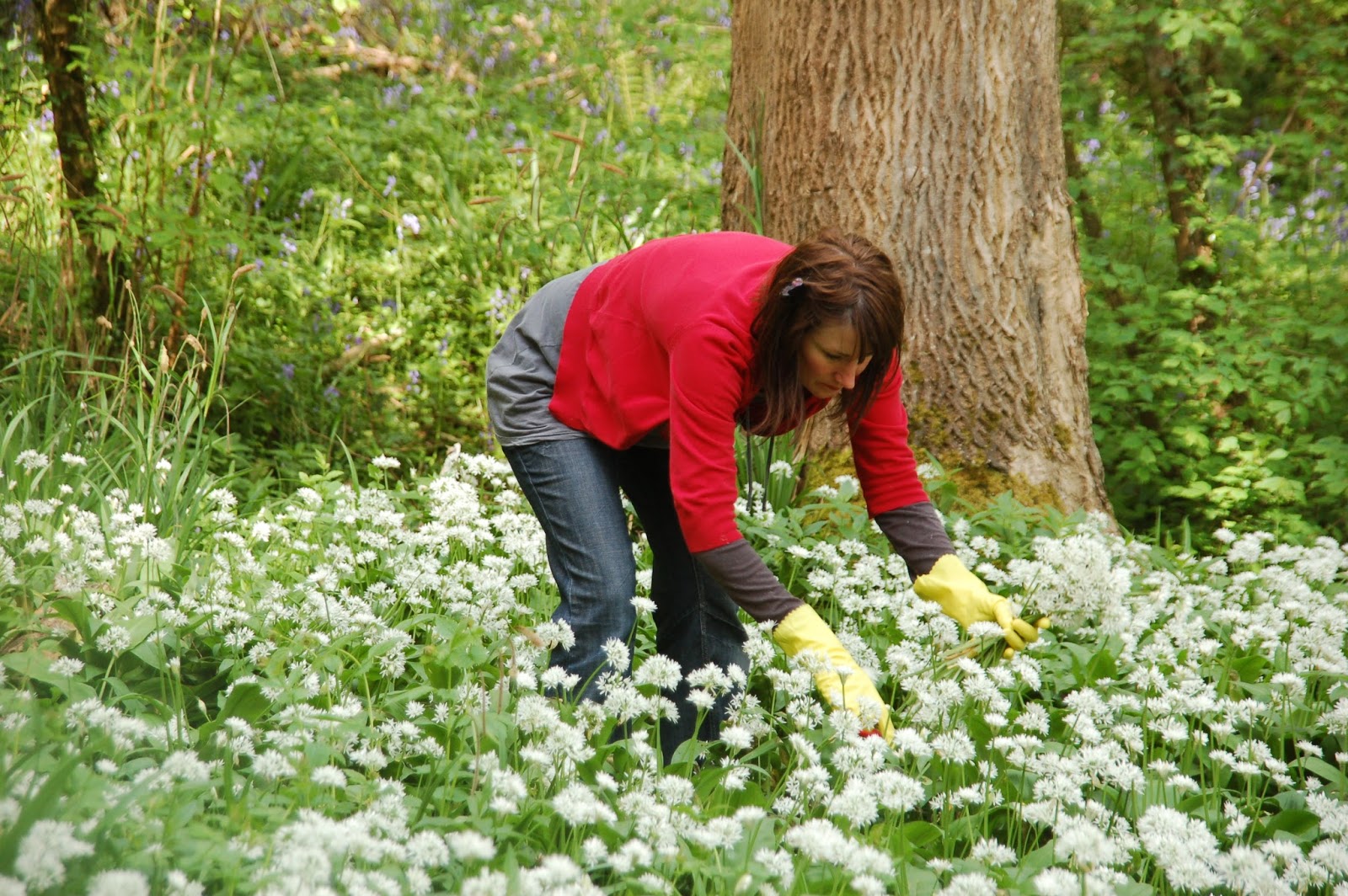
With Wild Garlic now in season we've had some delicious recipes shared with us.  You'll find it in woodlands, fields and roadsides. It is best eaten in early spring  - whilst it is at its most tender!

I hope you get a chance to do some foraging - it's great fun!!

Wild Spring Risotto

By Chris Westgate
Heavenly Hedgerows


2 large handfuls of nettle (spring tips are best)
20g Wild garlic 
100g butter
1 red onion
4C chicken or veg stock
100g grated Parmesan
1/2C white wine
2C risotto rice
1/4C mint

Finely chop the mint, nettles and garlic, put to one side.
Finely chop and fry the onion. Add the rice and gradually (1/2 a cup at a time until absorbed) add the stock (stirring constantly) When there is 1 cup of stock left, add the wine, nettles, garlic and mint. Finally at the end of cooking add the Parmesan and stir.  Serve immediately.


White beans with wild Garlic sauce

By Sue Currie
Netherton Foundry

400g cooked white beans (cannelini, haricot, butter beans - whatever you've got!)
200ml white wine
200ml chicken or vegetable stock
1 onion, sliced
1 dstsp grain mustard
100ml single cream
1 large handful Wild garlic, washed and chopped finely
Salt and pepper

Put the wine and stock in a pan and bring to the boil.  Simmer until reduced by half.
Gently fry the onion in rapeseed oil, with a knob of butter, until translucent and soft
Add the onions and mustard to the reduced stock mixture and stir well.  Add the cream and warm through.
Toss in the Wild garlic, season with salt and pepper.

Serve - with crusty bread, sausages, lamb chops or a nice piece of fish........... or any other combination that takes your fancy!

Nettle and Wild Garlic soup.

By Catherine
Cyril's Soap


Large knob butter
1 onion, chopped
1 medium potato (optional, but I think it thickens the soup up a bit) chopped
200g young nettle leaves, chopped
Couple handfuls Wild garlic , chopped
1 litre stock.
Melt butter and soften onion. Add potato, nettle and Wild garlic . Sweat for about 3 or 4 mins add stock and cook until all soft. About 30/40 mins. Allow to cool slightly and then whiz up in blender! Serve with crusty bread!


Wild herb dumplings

By Catherine
Cyril's Soap

100g flour
50g suet
Nettle leaves
May leaves
Dandelion leaves
Dock leaves
Cleavers (sticky grass)
Wild sorrel
Water


Use a couple handfuls of the above mixed herbs. Finely chop. Mix flour and suet and add herbs. Add water to make a dumpling mixture. Form into balls and add to spring/summer stews!

Tuesday, 5 March 2013

Why Livestock are important


With the pressure of feeding an ever growing population it has been suggested that livestock are a burden on the food chain.  The United Nations estimates that food supply needs to increase by 70-100% by 2050.  There are even some who suggest that going vegetarian would solve world hunger.  There is no doubt we need to do something, but is this the solution?

Presently a third of the world’s cereal harvest is fed to farm animals and for every 100 calories of cereals eaten by livestock only 30 calories of food is generated in the form of meat, milk and eggs.  It is estimated that if this cereal was used for human consumption it would feed 3 billion people.   

However, the question is more how we farm our livestock.  Factory farming often expounded as the solution to producing food more intensely is in fact highly resource intensive.  It means the livestock rely heavily on the type of cereals that would otherwise go into the human food chain. This is bonkers!  What’s more since the start of modern farming we’ve lost about a third of the world’s top soil.  This is one of our most valuable resources, without it we cannot grow anything.  Most of our fertilisers, pesticides and herbicides come from oil and this is very calorie inefficient.

If our livestock are raised in more natural conditions then they become an asset.  Many livestock can thrive in landscapes not suitable for raising crops and they naturally feed on things people would not want to eat.  Sheep on a moorland, pigs through a woodland or chickens in our own backyards recycling our food waste.  Also livestock effectively through their metabolism produce fantastic natural fertilisers for the soil and help to improve our top soil and increase the sustainability of the land. 


The key is to place the right livestock in the right place.  In fact the Shropshire sheep, once close to extinction, has found a new application.  It is one of the few animals that eats exclusively grass and has been used to great effect by tree growers and vineyards to keep the grass down, saving the growers time and money in maintenance.

Do livestock have a place in an ever stretched planet?  Yes, a crucial one.  Not in inefficient, intensive systems but in a more natural environment, earning their keep through the food and soil fertility they leave behind.  Would you want to see a landscape with no animals in it?

Monday, 25 February 2013

‘Safe’ Nuclear Energy?


I've never been a fan of nuclear. I've always felt we can go a long way by reducing our energy wastage and increasing our use of renewable energy technology. Most of Muddy Carrot  HQ's energy usage is derived from the sun, either passively through the solar energy that streams through the south facing windows, or through renewables - the solar panels heating the water and PVs generating electricity. There is no central heating, but loads of insulation. This is not complicated, or expensive technology, just clever thinking in the construction. I also know a couple of farmers that have turned to farming the sun with fields full of solar panels their sheep can happily graze and shelter beneath.  

One country that has made huge CO2 savings by being very forward thinking when it comes to sustainability is Germany and, though they are very effective, they still can not gain all their energy from renewables.

The recent nuclear popularity in turning to uranium fission power stations as a way to generate more electricity whilst keeping CO2 levels low has come to an end, with the Fukushima melt down that spread dangerous radioactive waves throughout the surrounding area. It could have been even worse if it was not for a team of heroic firemen that put their own health at risk in a determined effort to cool the reactor. What happened that day is likely to have a long term effect on Japan.

However, theoretically there is a far more stable and plentiful means of generating nuclear energy. Thorium.

There are numerous benefits of thorium over uranium, the key ones being:

Distribution of Thorium reserves across the globe
  • There is a plentiful supply of thorium and it is far more easily extracted than uranium.
  • Thorium is also much less radioactive than uranium, allowing far more stable reactors. 
  • It is also considerably more energy dense; you could hold a lifetime supply of energy in thorium in the palm of your hand.
  • It does not have the by-product of plutonium used in nuclear weapons.
Further research into thorium reactors is supported by some key environmental protection groups who are anti traditional nuclear power stations, including the influential Friends of The Earth who believe that this could indeed be the way forward.  

Thorium is not a new idea. The idea was first successfully tested in the 1950's, but the military saw the advantage of Uranium with the generation of Plutonium for their war heads and governments invested in the development of Uranium power stations over Thorium Power Stations.  

Theoretically thorium reactors would be based on the very early molten salt reactors which would not explode if overheated due to the fact that the salt contracts rather than expanding causing the reactor to remain sub-critical. The Thorium reactors would also be far more efficient at being cleaned than traditional uranium stations, with the waste being less harmful than uranium waste and able to be re-cycled.

It all sounds very good, but it has so far only been tested at an experimental level. Although this may seem amazing on paper it may take considerable time to develop it to a commercial level, and with nuclear energy having a messy past of horrific failures it has a lot of powerful opposition who don’t want any more nuclear disasters - thorium reactors may never catch on. 

Tuesday, 12 February 2013

Tomorrow World...


Ever since the Industrial revolution technology has moved forward at an incredible pace as we seek more labour-saving ways of doing things.  Often the pace and types of changes have been unsettling to many.  

When I went to University over 20 years ago there was no internet to turn to for information and my University main computer took the whole ground floor of one building.  What's more, much of what I learnt then is of no practical value now!!  At a similar age my Mother saw the old faithful carthorse, Dinah replaced with a modern tractor and this sparked the start of a huge revolution on the farm.

But what of the future of our modern day farms?

There is no getting away from the fact that in the future the world is going to need to be less resource hungry than it has been in recent times.  This Earth has limited resources and we've been a bit like stroppy teenagers trampling heavily on Mother Earth.  It is time for us to now knuckle down and become more responsible.  Also the public's faith has been tested through the poor traceability of food sold through some national supermarkets.  

There is presently a branching of opinions on the way forward.

There are many who are looking to science to guide them.  Focussing on the need to increase productivity by embracing modern technology such as "precision farming".  This involves the complete analysis of the farm's requirements, feeding it all into a computer and allowing the computer to guide the farming.  This can even go right down to GPS guided tractors driving themselves and fertilising the fields to mm precision.   This can have the advantage of a reduction in wastage caused by human error, together with increased yields.  However the weight of enormous modern tractors compacts the ground and the sustainability of primarily relying on artificial fertilisers in agriculture is questionable and it can be a polluter of our drinking water.

Scientists are also looking into developing  Robotic bees in response to the decline in the bee population.  The technical side of me would love to see one, but not to replace the real thing!


On the other side is a focus on our present wastefulness, and the need to act more sustainably.  The UN Food and Agriculture Organization (FAO) released figures in 2011 showing  approximately one third of the world's total food production is lost each year.  With our present weather you can see how some of this can happen, however a large amount of this could be reduced.  The desire to do things sustainably is also seeing the revival of many old practices.  In certain niche roles the working horse is proving very cost effective.  Their high manoeuvrability has made them ideal to work in woodlands, logging trees.  They do far less damage than any machinery could and are quick and efficient, making them perfect especially in ecologically sensitive areas. 

All Muddy Carrot's producers tread very lightly on the soil, including Chris from Heavenly Hedgerows who forages for her key ingredients.

I'm old enough to remember the TV programme Tomorrow's World and the many incredible ideas that we were expected soon to be using, though I believe that Star Trek has been a better predictor of the future with sliding doors, and mobile phones! Time will tell the way we go, but I feel that the primary tester should be sustainability and this could mean embracing the best of both worlds and caring about the roots of all our food.

What do you think?